






When the trailers for Dungeons & Dragons: Honor Among Thieves dropped, there were arguments online (because there are always arguments online). Two of the most common sides of the arguments were one group feeling that this was yet another Hollywood movie that didn’t take the thing we love at all seriously, with another group feeling that they perfectly nailed the dynamic of how actual D&D players interact with each other.
For what it’s worth, I’m with the latter group, and having now seen Honor Among Thieves, my main thought is that they perfectly nailed the role-playing game experience, but also made a damn fine movie. And that’s no mean feat.
SPOILERS FOR DUNGEONS & DRAGONS: HONOR AMONG THIEVES HEREIN! DON’T SAY I DIDN’T WARN YOU!
One of the challenges in adapting stories across media is finding the balance between keeping what makes the original appealing, but also fulfilling the storytelling needs of the medium into which it’s being adapted.
To give an example from my own bibliography, I’ve written three novels based on the TV series Supernatural. One thing I always try to do in tie-in fiction is bring something to the table that prose could do that the show couldn’t: in this case, embrace the location. For fifteen seasons on the CW, Sam and Dean Winchester drove all over the country, but everywhere they went looked just like Vancouver, where Supernatural was filmed. A novel isn’t constrained by location shooting needs, so I took the Winchesters to New York City, to Key West, and to San Francisco, places they were never likely to go (at least not visually convincingly) on television.
One of the best examples of fulfilling the needs of both media is the 2002 Spider-Man movie. In his inaugural appearance in the comic book Amazing Fantasy #15 in 1962, Peter Parker started his life as Spider-Man in a wrestling ring, winning a contest to defeat a heretofore undefeatable foe. Someone robs the till, and Spidey lets him run past, saying he’s only looking out for himself now. That same thief would go on to burgle the Parker household and kill Peter’s uncle Ben, who helped raise him, giving him the belated lesson that with great power comes great responsibility.
In the Sam Raimi-directed movie, Peter only gets a fraction of the money expected after the wrestling match. When Peter complains, the promoter shrugs and says, “I missed the part where that’s my problem.” Later, when the box office is robbed, Peter lets the guy go, and when the promoter complains, Peter shrugs and says, “I missed the part where that’s my problem.”
This was genius, because the tropes of big summer action movies are such that that’s supposed to be a moment of awesome for the character who throws the line of dialogue back in an asshole’s face. But it’s turned on its ear a few minutes later when Peter finds his uncle dead on the street, the victim of a carjacking by the very same thief. It takes an old comics story and gives it a new sheen by using the expectations of action movie heroes to make it that much more compelling.
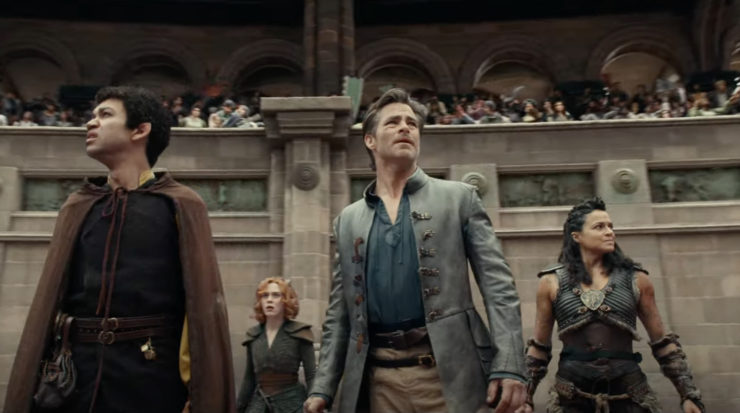
What makes Honor Among Thieves an absolute delight is that it takes just enough from the RPG it’s based on to be instantly recognizable to gamers, but also uses plenty of action-movie plot twists, characterizations, and tropes to work as a feature film.
(One thing the movie doesn’t take from D&D is the name of its creator, which is massively disappointing. The movie is billed as being based on the game from Hasbro, but Gary Gygax, the creator of D&D, gets nary a mention. While the filmmakers and Hasbro weren’t legally obligated to credit Gygax, thanks to Gygax’s acrimonious departure from TSR—which was later acquired by Wizards of the Coast, which was in turn acquired by Hasbro—leaving his name completely off it is a really bad look, and both filmmakers and game company should be ashamed of themselves.)
Creating fiction based on games is a particular challenge because the needs of a game are different than they are for a work of fiction—the Venn diagrams overlap some, but not entirely. For one thing, a game—particularly an ongoing tabletop RPG, of which D&D is the most venerable and popular example—has no obligation to provide a satisfying plot with a beginning, middle, and end. The only purpose is to give the characters something to do, but it’s not necessary for it to have the neat structure that fiction requires.
So Honor Among Thieves has to have an actual plot that fits into the movie’s running time. But it also provides all the characters with something to do, and does so in a manner that will be instantly familiar to anyone who’s spent time playing tabletop RPGs.
First off, there’s the straight-up quest narrative, which is one part of the Venn diagram I mentioned two paragraphs ago that overlaps both RPGs and heroic fiction. Our heroes must find a thing, and then find another thing, and then do a thing, which involves breaking into a place, and along the way they fight things.
There are several instances throughout the movie where I was seeing something familiar that could have been taken directly from my own RPG experiences. “Okay, he rolled a 1 there.” (Like when Justice Smith’s Simon accidentally steps on the wrong stone, thus collapsing the bridge they need to get across.) “All right, here’s where the DM takes pity on them and gives them something to help move the quest along.” (Right after that, when Simon realizes Michelle Rodriguez’s Holga has a staff that is also a magical item.) “Hey look, it’s an NPC here to provide exposition and guidance.” (Regé-Jean Page’s Xenk, a paladin, who really is the perfect non-player character.) “Oh my goodness, they’re rules-lawyering!” (When they’re going back and forth about how it works when they resurrect a corpse and ask it five questions before it can go back to being dead.) “Ooh, man, they should’ve checked for traps.” “Missed their surprise roll, there.” “Someone needs a wisdom check.” And so on.
Plus there are lots of cool nods to the game, from the gelatinous cube (the single best monster in the history of monsters) to Sophia Lillis’ Doric changing into an owlbear to the fact that a bard is functionally useless in a combat situation. Seriously, I started gaming in 1982, and in the four decades since then, I’ve never seen a bard do anything useful in combat that didn’t involve, say, rolling a 20 while clubbing somebody with a lute.
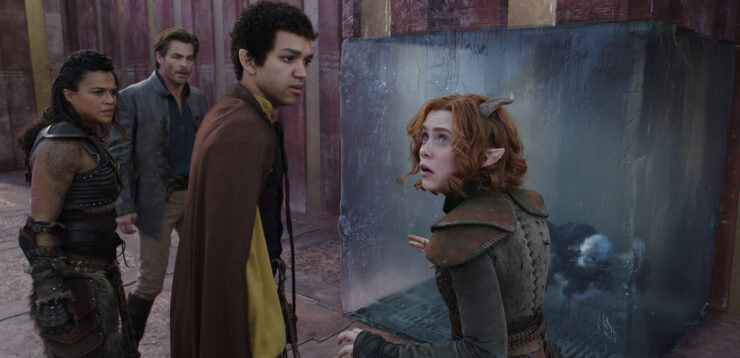
There’s also the lovely Easter egg for fans of the D&D animated series that ran from 1983-1985, as one of the other groups in the arena going through the big-ass maze are very obviously the characters from that series.
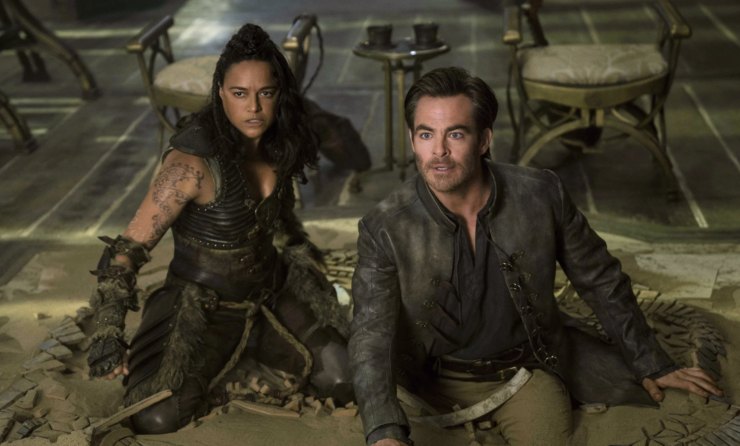
But this is also a strong film in its own right, one that makes use of the tropes of modern action movies. It starts at the top, with the male lead being a snarky white guy named Chris, which is a contractual requirement for any theatrical release in the United States in the twenty-first century. (This may be an exaggeration.) In this case, it’s Pine, playing the aforementioned bard, Edgin Darvis, who has a plotline that is pure movie schmaltz. He has a dewy-eyed wife who dies tragically (sigh—must we constantly fridge our female characters?). He has a daughter, Chloe Coleman’s Kira, for whom he would do anything. But Kira has been suborned by a former friend (Hugh Grant’s magnificently sleazy Forge), and Edgin has to win her back. Oh, and then, when given the chance to resurrect his dead wife (who died when Kira was an infant), he instead resurrects Holga (who helped raise Kira). That, in particular, is a total movie moment, as I suspect many gamers would stick with Plan A and resurrect the wife—or, if they did choose to resurrect Holga, it would be because they want her around for fights, not because Kira made pleading facial expressions at them.
The pacing is also superb, which is critical. RPG campaigns can go on for years, after all, and often go in fits and starts. (“We’re gonna send Mary on a side quest this week, ’cause she’s on vacation until September.” “We can’t meet next month, I’m going to a convention.” “Wait, did we just waste the entire session arguing about that damn resurrection spell?” “We gotta end early this week, you guys got through the dungeon too fast, and I don’t have the next bit ready yet.”) However, the movie moves briskly, never dragging, but never rushing, either.
Above all else, what makes the movie work is the balance. There’s just enough movie stuff in there to work for a general audience who are just in it for the cool fantasy stuff and to watch Pine, Rodriguez, and the rest. There’s just enough gaming stuff to feel incredibly familiar to anyone who’s rolled up a character then lived in fear of what the DM is rolling behind the screen where you can’t see it.
The result is a D&D movie that actually succeeds in the general marketplace, made by people who understand the appeal of both RPGs and movies.
Now we just need to know when we get the sequel…
Keith R.A. DeCandido has written sixty novels in a three-decade writing career. One of them was an actual Dungeons & Dragons novel—the 2011 Dark Sun novel Under the Crimson Sun—and his original series that began with Dragon Precinct is very much inspired by his formative years doing role-playing games. He has been writing about pop culture generally and Star Trek and screen adaptations of comic books in particular for Tor.com for a dozen years now.


Saw it last night – the pacing and tight writing really elevated this film above its roots – worth noting, John Francis Daley was both a writer and director. You may also know him as Sweets, from Bones he left the show to pursue writing and directing – one of his credits as a writer was Spider-Man: Homecoming.
It was a really fun and well balanced film. Makes me almost look forward to the upcoming version of M.A.S.K. he did the early draft for :)
It was pure unadulterated popcorn fun with enough DnD lore to keep my adventurer heart happy. Absolutely nerded out when Otiluke’s Resilient Sphere was cast, figured out Simon must have a Bag of Holding because Ed kept handing him stuff exactly like we do to our caster bagholder and enjoyed the TTRPG realism of multiple redundant plans because of obvious Nat 1s.
Looking forward to seeing it eventually. But also:
Critical Role‘s Scanlan Shorthalt would like a word with you. ;)
3rd edition (and Pathfinder, built off of that) did all right by bards, I only played in 1 game in 4e as a paladin, but 5th ed’s done well by the minstrels. Sure, can’t always pull the big numbers of a barbarian or wizard (unless you go for certain builds), but a bard’s value is in support spells and skills to make those guys even better–or the enemies worse. And realizing how hilariously broken certain spells in PF are as written to, for instance, drop party members in the most advantageous spot on the map, like teleporting the rogue right behind the guy I’d just cast Hold Person on…
While they shine in the roleplay moments outside of fights, a good bard player knows how to use their abilities to control the course of combat, even if they aren’t inflicting a single point of damage themselves.
LynMars: I might have been exaggerating for effect.
—Keith R.A. DeCandido, who also might not have been…
On a different take, I don’t see Xenk as an NPC. He’s a friend of the DMs from an older campaign who could only make it for part of this one. And we will see more of him later.
It was such a good movie, totally took me by surprise the quality and balance and everything you mentioned above. God, I hope they make more. Great article!
I wonder how D&D: Honor Among Thieves compares to my touchstone for media depictions of roleplaying, the “Advanced Dungeons & Dragons” episode of Community.
As a man who knows a bit about various DUNGEONS AND DRAGONS settings, but almost nothing about playing the game (I’m in it for the background, mostly), I really enjoyed this – but remain astonished that this particular fellowship of rascals managed to go through a whole adventure without a cleric (or other healer) and only one PC death.
They must have a very easygoing DM.
“I’ve never seen a bard do anything useful in combat”
You just to know how to use them.
#8 ED — There was an article with the directors and they did acknowledge they didn’t do much with clerics because it has a tendency to dilute tension when there’s healing and resurrection added to the mix. So at least they did think about it!
It’s actually great that Gary Gygax wasn’t credited. For one, he was a bad person and it’s better not venerate him. For another, he screwed over and didn’t credit the other people who contributed to the creation of dungeons and dragons.
Wittgen: While you’re not wrong in anything you say, Gygax still was the primary mover and shaker behind the game. It’s not a matter of venerating him, it’s just a matter of acknowledging his very very large role in the creation of the thing the entire movie was based on. Even just a character named Gygax would’ve done the trick. (Wouldn’t even have to be a nice character….)
—Keith R.A. DeCandido
I liked the movie, abd my wife who never played D&D also liked it.
But I don’t think it’s going to have a sequel. It’s underperforming and it’s not going to make its budget back (called a flop or bomb in Hollywood language). With Mario Bros movie coming out this week I can see Paramount having a huge loss from this movie (which cost 150 million to make).
So to the bin that has movies that I liked but most general audiences didn’t this goes. It’s going to join Alita and Dredd.
Reviews talk about the game’s influence on the movie, but one of the things I loved about the movie is how much inspiration it can give to the game. For example, some of the plans they came up with were brilliant i.e. smuggling the painting into the vault, and I can definitely see players being inspired to use that same type of out of the box thinking. Xenk is probably my favorite character from the movie and makes me want to try my hand at a paladin (I think paladin and warlock are the only two classes I’ve never played). And every DM should take note of how Simon’s illusion spell went awry when he lost his concentration. Once again, brilliant!
One thing that I think was wonderful – many movies based on something with a lot of lore or history (whether it’s a game or a Lovecraft adaptation) seem to feel the need to spend time on infodumps or a minute and a half of exposition to explain why X is so cool (and Y, and Z, and A, and B, and…). Here, they dropped the name, showed a bit, and then trusted the viewer to figure it out on their own, whether it was “Wizards of Thay are bad” or “Harpers are the good guys” or “the Underdark is a bad place to get lost in” and it worked so well. Really enjoyed it, and loved all the easter eggs (busted out laughing every time I saw the old DnD cartoon characters).
@11. Wittgen – Dave Arneson is the Bill Finger of role-playing games. He is at least as important to the game’s early history as Gygax, and it’s a crime that he’s not given more credit.
The only upside to my foolish decision to attend Full Sail University in 2002 was that I got to take Arneson’s class. The man was an utter delight.